Charles M. Russell
"Charlie Russell painted more than one famous canvas. We live in them."
Drag & Drop elements for the Sidebar here

|
From our scenic mountains to our wide open prairies, we can still boast the same beautiful country that Charlie Russell described & painted. Explore the Judith Basin and ride the Russell Trail! The land continues to stir the imagination and spirit today as it did for a cowboy artist over 100 years ago.
Charles M. Russell
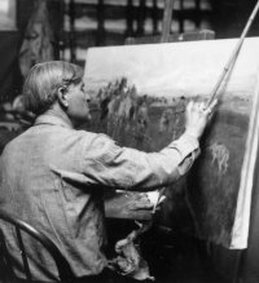
Charles Marion Russell (March 19, 1864, St. Louis, Missouri—October 24, 1926, Great Falls, Montana) also known as C. M. Russell, was an artist of the American West.
Russell created more than 4,000 works of art including paintings of cowboys, Indians, and landscapes set in the Western United States in addition to bronze sculptures. Many of the landscape settings seen in his works of art are still visible today right here in Judith Basin County. Russell was also a storyteller and author. The C.M. Russell Museum located in Great Falls, Montana houses many of his artworks, personal objects, and artifacts. Russell's mural entitled Lewis and Clark Meeting the Flathead Indians hangs in the state capitol building in Helena, Montana. Russell's 1918 painting Piegans sold for $5.6 million dollars at a 2005 auction. Childhood Art was always a part of Russell's life. Growing up in Missouri, he drew sketches and made clay figures of animals. Russell had an intense interest in the wild west and would spend hours reading about it. Russell would watch explorers and fur traders who frequently came through Missouri. Russell learned to ride horses at Hazel Dell Farm in Jerseyville, Illinois on a famous Civil War horse called "Great Britain". Russell's instructor was Col. William H. Fulkerson who had married into the Russell family. At the age of sixteen, Russell left school and went to Montana to work on a sheep ranch. Russell returned to Missouri and Illinois in the winter of 1882 to visit family. Russell's cousin James Fulkerson, nine months younger, was persuaded to join Russell working on a Montana cattle ranch. However, as Russell later wrote, his cousin "died of mountain fever at Billings two weeks after we arrived" on 27 May 1883. Discovery In 1882, by the age of eighteen, Russell was working as a cattle hand. He teamed up with a local hunter, Jake Hoover, of which he spent two years sharing a cabin on the South Fork of the Judith River located south of Utica. The harsh winter of 1886 and 1887 provided the inspiration for a painting that would give Russell his first taste of publicity. According to stories, Russell was working on the O-H Ranch in the Judith Basin of Central Montana when the ranch foreman received a letter from the owner, asking how the cattle herd had weathered the winter. Instead of a letter, the ranch foreman sent a postcard-sized watercolor Russell had painted of gaunt steer being watched by wolves under a gray winter sky. The ranch owner showed the postcard to friends and business acquaintances and eventually displayed it in a shop window in Helena, Montana. After this, work began to come steadily to the artist. Russell's caption on the sketch, Waiting for a Chinook, became the title of the drawing, and Russell later created a more detailed version which is one of his best-known works. Adulthood In 1896, Russell married his wife Nancy. In 1897, they moved from the small community of Cascade, Montana to neighboring Great Falls, where Russell spent the majority of his life from that point on. There, Russell continued with his art, becoming a local celebrity and gaining the acclaim of critics worldwide. As Russell kept primarily to himself, Nancy is generally given credit in making Russell an internationally known artist. She set up many shows for Russell throughout the United States and in London creating many followers of Russell's. Russell the artist arrived on the cultural scene at a time when the "wild west" was being chronicled and sold back to the public in many forms, ranging from the dime novel to the wild west show and soon evolving into motion picture shorts and features of the silent era, the westerns that have become a movie staple. Russell was fond of these popular art forms, and made many friends among the well-off collectors of his works, including actors and film makers such as William S. Hart, Harry Carey, Will Rogers and Douglas Fairbanks. Russell also kept up with other artists of his ilk, including painter Edward "Ed" Borein and Will Crawford the illustrator. On the day of Russell's funeral in 1926, all the children in Great Falls were released from school to watch the funeral procession. Russell's coffin was displayed in a glass sided coach, pulled by four black horses. A collection of short stories called Trails Plowed Under was published a year after his death. Also, in 1929, Russell's wife, Nancy, published a collection of his letters of which was titled Good Medicine. The source of this article is Wikipedia, the free encyclopedia. The text of this article is licensed under the GFDL. |
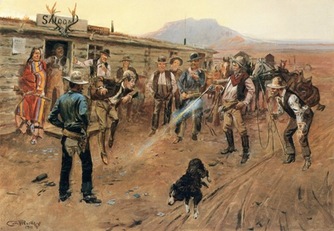
"Tenderfoot" by Charles M. Russell
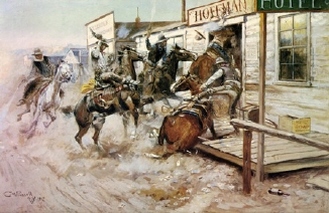
"In Without Knocking" by Charles M. Russell
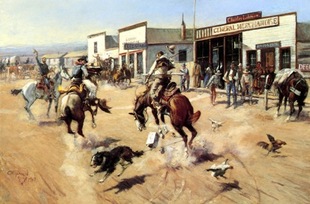
"A Quiet Day in Utica" by Charles M. Russell
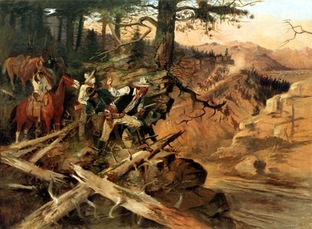
"The Ambush" by Charles M. Russell
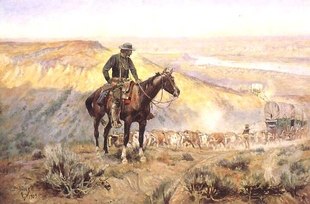
"The Wagon Boss" by Charles M. Russell
"Charlie Russell's Trail" Among the pictures of heroes and friends, that I've hung on my office Wall, Is a print of a painting made by Charlie Russell, The best cowboy artist of them all! The Wagon Boss, (a French Metis) Sits easy on his horse, Watching Ox teams in the background, on their winding up hill course. Through the Missouri River Breaks, from the crossing at Bent's Fort. I can hear the Teamsters curses, and the bullwhip's loud report. Charlie Russell, like that wagon boss, blazed his own trail through the West. A path that many seek to follow, Because Ol' Charlie did it best! C.M. Russell Poetry Contest Winner, 2005 Mike Puhallo, Copyright 2005 Email: mikepuhallo@direct.ca |